

Throughout time, several studies have investigated the way shapes are processed by the human mind and the possible influence they can have in different contexts. It has been shown that shapes have a powerful impact on the way people perceive objects and environments and such perception influences their decision-making and behaviour. In every context, each shape can have different meanings and lead people to perceive the space and the objects within it in a certain way.
Interestingly, the majority of research has always shown a preference for smoothly curved contours that are generally processed as more pleasant. This result has led to the definition of the phenomenon called ‘the smooth curvature effect on preference’ that has been confirmed with a variety of visual stimuli from abstract meaningless shapes or patterns to more articulated displays such as pictures of interior design spaces or even familiar objects. In the majority of previous studies, explicit measures of preference were used (e.g., rating scales of liking).
Recent research has further investigated this concept intending to confirm the previous results with different measures. The study aimed to identify if in the preference formation for curvature, forced-choice response methods differ from rating scales and if it matters whether the question is about liking or attractiveness. To do so, three experiments were carried out. In the first one, participants were quickly shown abstract curved or angular shapes and they had to indicate whether they liked or disliked each shape. Using the same stimuli, in the second experiment, participants had to rate how much they liked each shape (from 0 to 100) and then in the third one, they were instead asked to rate the stimuli in terms of attractiveness.
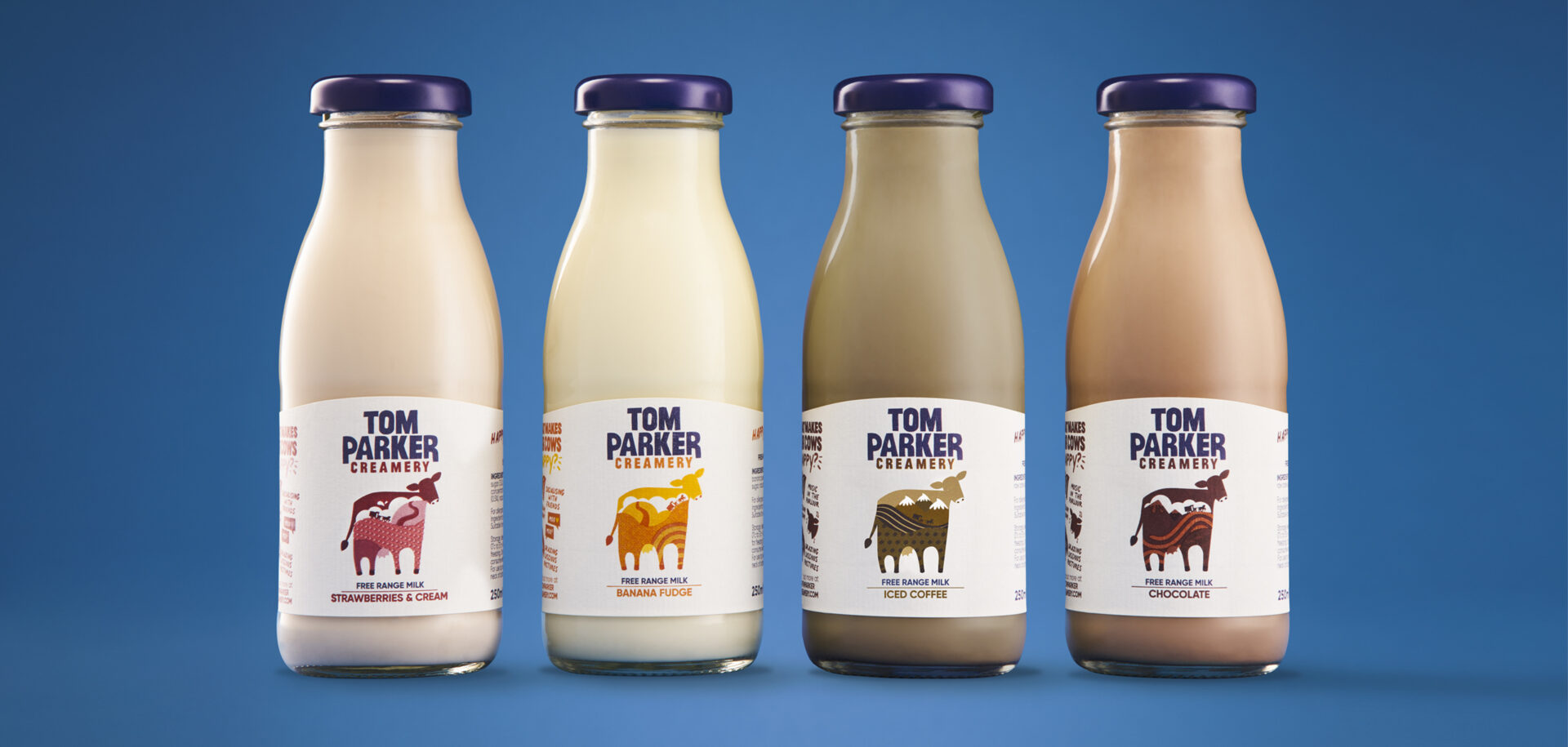
Tom Parker Creamery brand designby White Bear Studio
In all three experiments, curved shapes were preferred. Interestingly, the preference for curvy shapes was more enhanced in the first experiment suggesting that when participants are forced to select between two options, it is the curvature that drives their response. A further interesting result is that participants preferred shapes with a balanced number of vertices and concavities across tasks. However, with the use of rating scales, the researchers showed that participants tend to prefer star-like shapes, shapes with more concavities.
These results are quite interesting and the first thing that came up to our minds is their possible application to product design. Knowing that the human mind tends to prefer smoothly curved contours is per se a significant element. Designing a product with a curved shape could increase the likelihood of consumers’ attention toward the product and also their willingness to choose it among others. Moreover, in the case in which a customer is not sure which product to select between the two, the curvature of the product could be the differentiating factor that further encourages the customer to buy one of the products.
Following this, it might be truly worth it then, to apply this knowledge to future product design.